
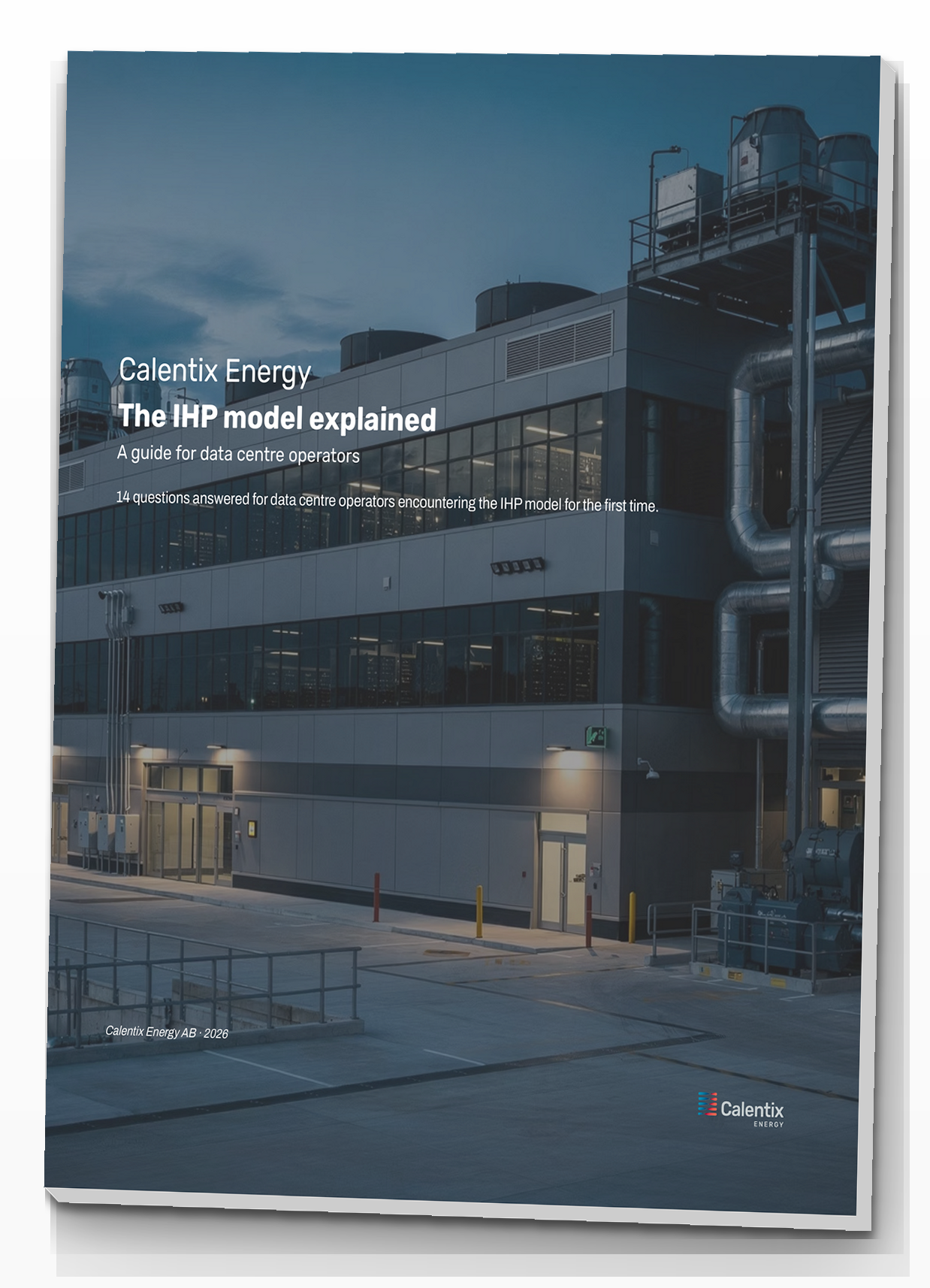
The Independent Heat Producer model (IHP) turns the heat your data centre already throws away into a working energy asset, with no capex, no extra staff, and no change to your cooling system.
Download the free guide to see exactly how it works.
Fill out the form to get the guide in your inbox.
Get the guide in your inbox
What's inside
- What an Independent Heat Producer actually does
- What's required from you (less than you think)
- The Energy Reuse Factor, project timelines, and site viability
- The most common reasons projects don't proceed
- How data centre waste heat recovery can be implemented in a smart way
About the author

Markus Wråke — 20+ years at the IEA, IVL, and as former CEO of Energiforsk. Now leading Calentix Energy's mission to connect European data centre waste heat to district heating networks.
Frequently asked questions
A commercial framework where a specialised developer, Calentix, sets up a dedicated project company that finances, builds, owns, and operates the heat recovery system that connects a data centre's cooling circuit to a district heating network. The data centre provides access; the IHP handles everything else.
No. The connection is non-invasive (two isolation valves and a heat exchanger). Cooling capacity and redundancy remain at 100%. If the heat pump pauses for any reason, an automatic bypass restores normal flow within seconds.
The project company set up by Calentix owns 100% of the heat exchangers, heat pump units, pipework, electrical connections, and monitoring systems. The data centre carries no capital expenditure and no balance sheet liability.
A liquid cooling interface point, physical space (typically the equivalent of one or more containerised units), an electrical connection for the heat pump, and read-only access to operational data such as cooling water temperature and IT power draw.
Typically 18–36 months from first conversation to first commercial heat delivery: 2–6 months for feasibility, 6–12 months for design and contracting, and 6–12 months for construction and commissioning.
Liquid cooling with a return temperature ideally between 25 and 35°C, an IT load above roughly 2–5 MW, proximity to an existing district heating connection point (within 1–2 km), and a supportive regulatory or commercial environment.
Your data centre is unaffected. The original cooling infrastructure continues to operate at full capacity. Heat recovery is additive, not substitutive.
Tags:data centresguidesIHP
Fill out the form to get the guide in your inbox.